


Is Pittsburgh A Good Place To Live
Is Pittsburgh A Good Place To Live? An Honest 2026 Guide
Cost of living, jobs, neighborhoods, weather, schools, safety — a Pittsburgh native real estate team’s unfiltered take on what it’s actually like to live in the Steel City.
Table of Contents
The short answer: yes, with caveats
If you’re asking is Pittsburgh a good place to live, the honest, lived-in answer from a real estate team that has helped thousands of families move into and out of the city: yes, for the right person. Pittsburgh consistently lands in the top 25 of national livability rankings, ranks among the most affordable mid-sized metros in the country, and offers a quality of life that punches well above its weight class. It is also a city of microclimates, neighborhoods that feel like distinct small towns, and weather that will test you for four months of the year.
U.S. News ranked Pittsburgh among the top 100 best places to live in the U.S. for 2026, and it has appeared on Livability.com’s lists of best places for young professionals, families, and remote workers in each of the last several years. Money, Forbes, and Niche have all spotlighted Pittsburgh’s combination of affordability and amenity. The Greater Pittsburgh metro is home to roughly 2.4 million people across Allegheny, Westmoreland, Washington, Beaver, Armstrong, Butler, and Fayette counties.
This guide won’t sugarcoat. We’ll break down the real cost of living, the actual job market beyond the marketing slides, the personality of each neighborhood you’ll consider, and the deal-breakers that send some new arrivals back to the coasts within 18 months.
Cost of living in Pittsburgh
This is the headline answer for most relocating families: Pittsburgh is meaningfully cheaper than nearly every East Coast or West Coast metro of comparable amenity. The composite cost of living index sits at roughly 89 against a national average of 100. Housing is the standout — about 20–25% below the national average and 50–70% below New York, Boston, DC, or San Francisco.
Median home prices, Greater Pittsburgh (2026)
| Area | Median Sale Price | Median $/sq ft | YoY Change |
|---|---|---|---|
| Allegheny County overall | $248,000 | $165 | +3.4% |
| City of Pittsburgh | $235,000 | $184 | +2.1% |
| Mt. Lebanon | $435,000 | $215 | +5.0% |
| Cranberry Twp. | $485,000 | $210 | +4.6% |
| Fox Chapel area | $725,000 | $240 | +3.2% |
| Squirrel Hill | $485,000 | $240 | +1.8% |
| Lawrenceville | $385,000 | $295 | +2.7% |
| Mt. Washington | $305,000 | $208 | +4.1% |
Compared to a starter home in Boston or Brooklyn at $750K–$1.2M, Pittsburgh’s $235K median feels like a different planet. A six-figure software job that would qualify you for a one-bedroom condo in Cambridge buys a four-bedroom Victorian with a yard in Regent Square here.
Other cost-of-living anchors
- Groceries: within 1–3% of national average
- Utilities: 2–5% below national average; natural gas is cheap thanks to Marcellus Shale
- Transportation: 8–10% below national average if you own a car; very competitive if you live in a walkable neighborhood
- Healthcare: roughly at the national average — but with UPMC, AHN, and dozens of specialty providers nearby
- Income tax: PA flat 3.07% state tax + 1–3% local Earned Income Tax
- Property tax: meaningfully higher than national average; see our Allegheny County property tax guide
Pittsburgh jobs & the post-industrial economy
Yes, this was Steel City. No, it isn’t anymore. Pittsburgh’s largest private employer is now UPMC, the integrated healthcare and insurance system that employs over 90,000 people regionally. The University of Pittsburgh and Carnegie Mellon University combined add another 25,000+ jobs and feed a robust startup pipeline. PNC Financial Services, BNY Mellon, Highmark Health, and Allegheny Health Network round out the top employer list.
Where the jobs actually are
- Healthcare & life sciences: UPMC, AHN, dozens of specialty hospitals and biotech firms anchored around Oakland and the South Side
- Education: Pitt, CMU, Duquesne, Carlow, Point Park, Robert Morris, Chatham, Community College of Allegheny County
- Financial services: PNC, BNY Mellon, Federated Hermes, Dollar Bank
- Tech & robotics: Aurora, Argo AI alumni, Duolingo, Astrobotic, Locomation, Carnegie Robotics, Google Pittsburgh, Meta engineering
- Energy: EQT, Range Resources, CNX, plus a growing hydrogen hub initiative
- Manufacturing & advanced materials: still substantial, with U.S. Steel, Alcoa, PPG, Howmet legacy
Median household income in Pittsburgh is roughly $66,000 — meaningfully below national-average tech-hub cities, but the cost-of-living adjustment usually flips the math in Pittsburgh’s favor. A $110K Pittsburgh tech salary delivers comparable lifestyle to about $185K–$210K in Seattle or Boston after housing.
The remote-worker effect
Since 2020, Pittsburgh has been a major beneficiary of remote-work migration. We’ve personally helped hundreds of buyers move here from NYC, DC, Boston, San Francisco, and Austin while keeping their existing employer. The combination of housing affordability, walkable neighborhoods, and direct flights from PIT (Pittsburgh International Airport offers nonstops to roughly 60 destinations including London, Reykjavík, and most major U.S. hubs) makes it one of the country’s strongest remote-work landing pads.
The neighborhoods that define Pittsburgh
Pittsburgh has 90 official city neighborhoods plus dozens of suburban municipalities, each with a distinct personality. You can’t really evaluate is Pittsburgh a good place to live without picking the right neighborhood — there’s a difference of an entire lifestyle between Lawrenceville and Sewickley.
Walkable urban favorites
- Lawrenceville: trendy, restaurant-dense, Victorian rowhouses, young professional magnet, 36th–45th Streets are the heart
- Squirrel Hill: family-oriented, incredibly walkable, exceptional schools (PPS Allderdice + day schools), large Jewish community, Forbes & Murray business district
- Shadyside: upscale, Walnut Street shopping, leafy, near CMU/Pitt — popular with young professionals and grad students
- Mt. Washington: postcard skyline views, hilly streets, walkable to the Inclines and downtown
- Strip District / Lower Lawrenceville: warehouse-loft energy, food market culture, fast-changing condo and townhouse market
Family-focused suburbs
- Mt. Lebanon: top-rated schools, walkable downtown along Washington Road, traditional architecture, T (light rail) access into the city
- Upper St. Clair: top-rated schools, larger lots, classic suburban
- Fox Chapel area: wooded, prestigious, large lots, top schools, country-club community
- Cranberry Twp.: newer construction, family-heavy, in Butler County so different tax structure
- North Allegheny / Wexford: top schools, newer subdivisions, easy I-79 commute
Up-and-coming value picks
- Brookline: classic Pittsburgh affordability with strong neighborhood character
- Bloomfield: Pittsburgh’s “Little Italy,” walkable, restaurant-dense, just east of Lawrenceville
- Regent Square: small, walkable, indie shops, near Frick Park
- Aspinwall: small-town vibe along the Allegheny River, walkable downtown, top Fox Chapel schools
Considering a move to Pittsburgh?
We help relocating families decide which neighborhood actually fits — based on commute, schools, lifestyle, and budget. Free 30-minute relocation call.
Schools & raising a family
Pittsburgh’s school landscape is split into two very different stories. Inside the city, Pittsburgh Public Schools serves about 18,000 students across 54 schools. The district is uneven — some standouts (Allderdice, CAPA, Sci-Tech Academy) compete nationally; others struggle. Many city families either stay in PPS for elite magnets or shift to private/parochial.
Outside the city, the Western PA suburbs include some of the strongest public school districts in Pennsylvania. Mt. Lebanon, Upper St. Clair, Fox Chapel Area, North Allegheny, Pine-Richland, Hampton, and Quaker Valley regularly rank in the state’s top 25.
Notable private/parochial options
- Shady Side Academy (PK–12, multiple campuses) — large endowment, strong arts/STEM
- Winchester Thurston (PK–12, Shadyside)
- Sewickley Academy (PK–12)
- The Ellis School (girls, PK–12, Shadyside)
- Central Catholic / Oakland Catholic (single-sex Catholic high schools)
- St. Edmund’s Academy (PK–8, Squirrel Hill)
Family quality of life beyond schools
Pittsburgh has an exceptional density of family-friendly assets per capita: the Carnegie Museums (Natural History + Art + Science Center), the Pittsburgh Zoo & Aquarium, the National Aviary, Phipps Conservatory, Kennywood Park, dozens of city playgrounds, the new Frick Environmental Center, and a parks system anchored by Frick, Schenley, Highland, and Riverview parks. Most of these are either free, deeply subsidized, or covered by a single museum membership.

Weather, geography & getting around
Let’s address the biggest pushback we hear from people considering Pittsburgh: the weather. Pittsburgh sees roughly 165 sunny days per year, well below the national average of 205. November through February is genuinely gray. Winters are not as harsh as Buffalo or Minneapolis — average winter temperatures sit in the high 20s to high 30s — but the lack of sun is a real adjustment, especially for folks coming from Florida, California, or the Mountain West.
What the weather actually looks like
| Season | Avg High | Avg Low | Notes |
|---|---|---|---|
| Winter (Dec–Feb) | 38°F | 24°F | Snow days, gray sky, plenty of slush |
| Spring (Mar–May) | 60°F | 41°F | Wet, transitional, beautiful by May |
| Summer (Jun–Aug) | 82°F | 62°F | Warm humid, occasional 90°F+ stretches |
| Fall (Sep–Nov) | 64°F | 45°F | The best season — long, colorful, dry |
Geography that surprises newcomers
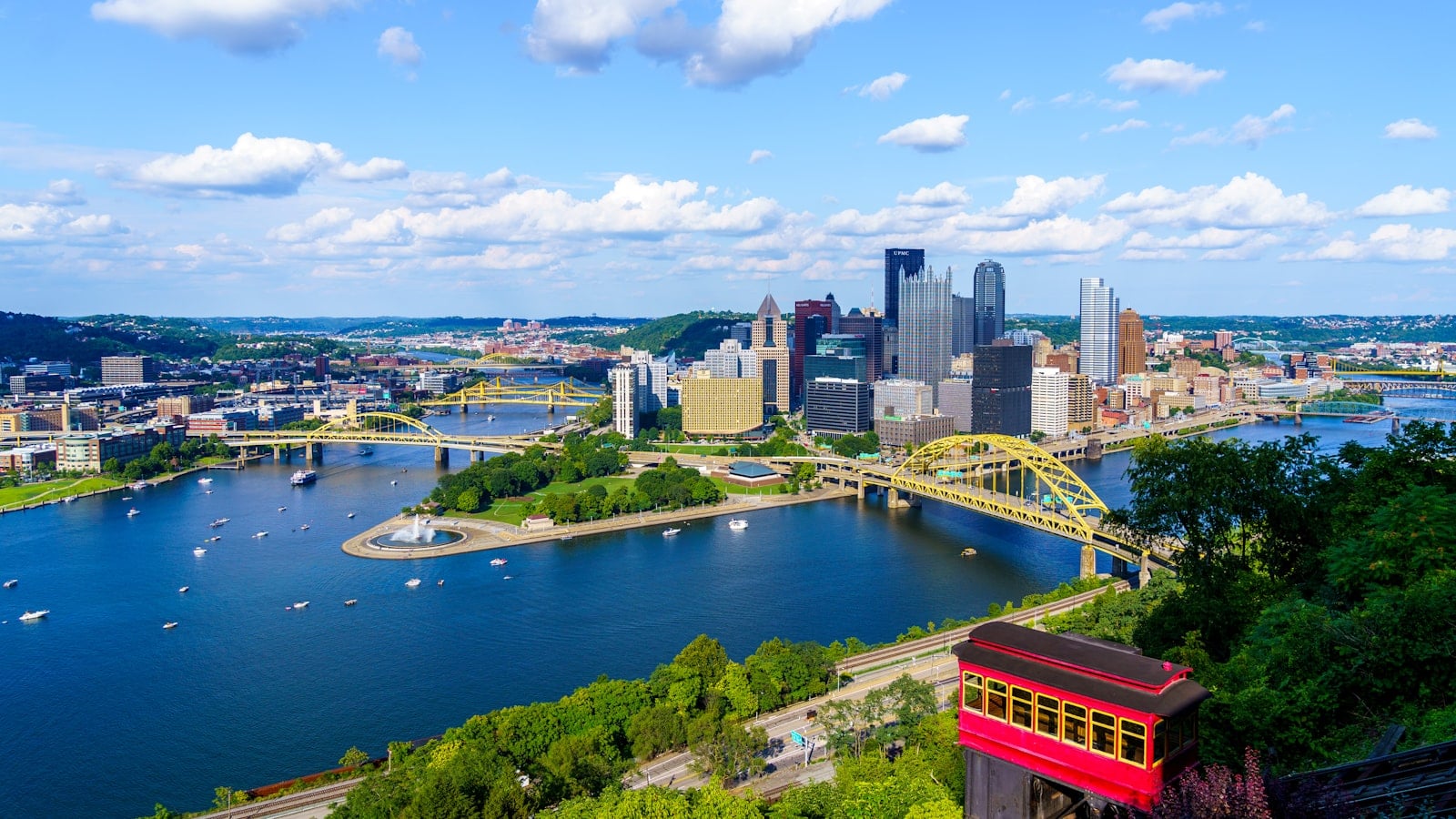
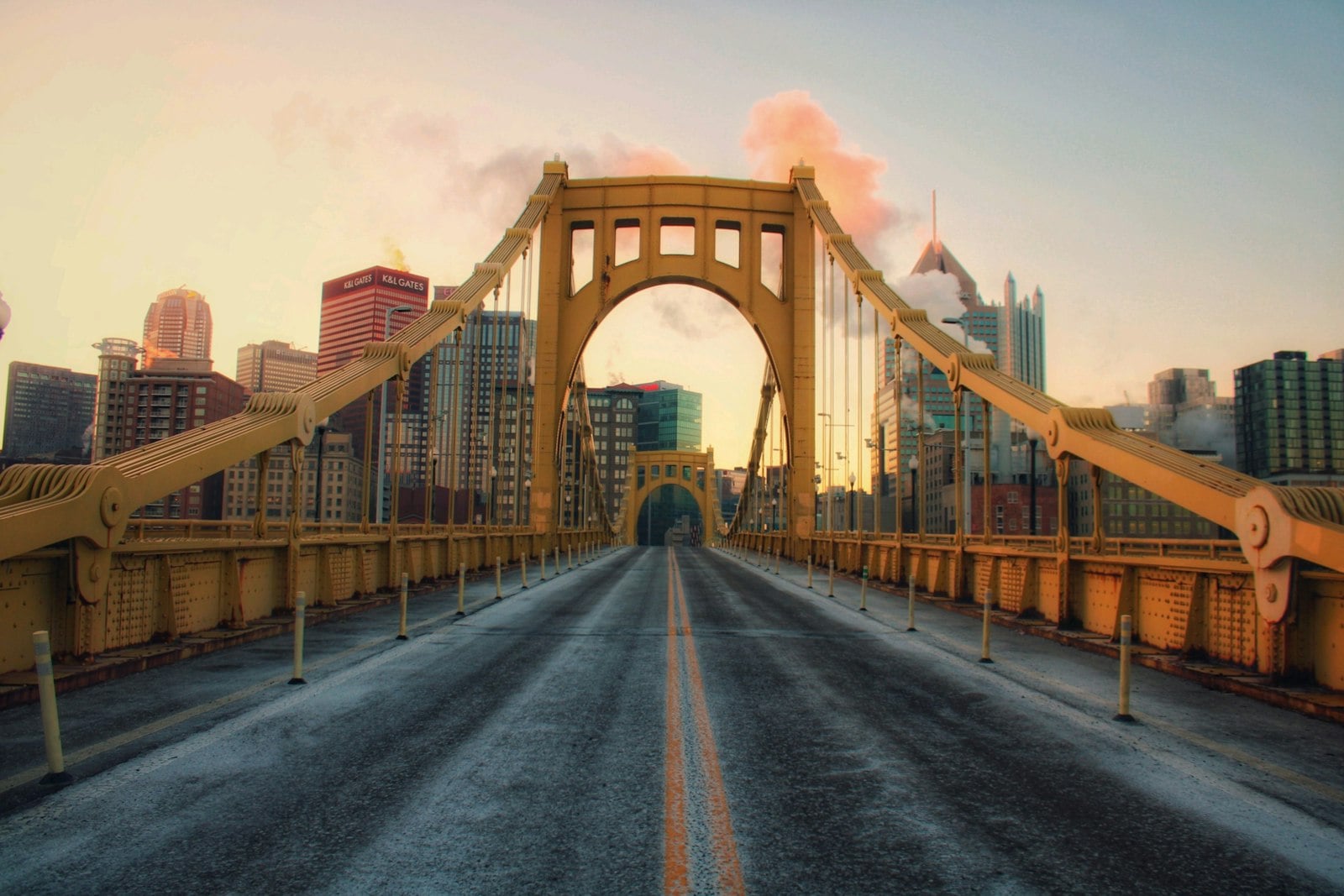
Pittsburgh is not flat. The city sits at the confluence of the Allegheny, Monongahela, and Ohio rivers, and the topography is a maze of hills, valleys, hollows, and bridges. There are 446 bridges within city limits — more than any other city in the world. Tunnels and bridges create real bottlenecks at rush hour, and the Fort Pitt Tunnel into downtown is a daily ritual for many commuters.
Getting around
- Driving: required for most suburbs; congestion is moderate compared to NYC or DC
- Transit: Pittsburgh Regional Transit runs buses + the T (light rail) into the South Hills and Downtown; reasonable for commuters from Mt. Lebanon, Dormont, South Side
- Walkability: excellent in Lawrenceville, Squirrel Hill, Shadyside, South Side, Mt. Washington, Bloomfield, Regent Square
- Cycling: growing network including the Three Rivers Heritage Trail and Eliza Furnace Trail
- Air: Pittsburgh International (PIT) — direct flights to 60+ destinations, low fares historically, easy 25-minute drive from downtown
Safety, crime & quality of life
Pittsburgh’s metro overall crime rate is roughly comparable to other mid-sized American cities. The city itself trends slightly above the national average for property crime and slightly above for violent crime — but, critically, those numbers are driven heavily by a handful of specific neighborhoods. Most of the residential areas where buyers actually want to live (Squirrel Hill, Mt. Lebanon, Fox Chapel, Shadyside, Mt. Washington, Cranberry, Sewickley) have crime rates well below the national average.
What residents say in surveys
- High satisfaction with neighborhood safety (Squirrel Hill, Mt. Lebanon, Upper St. Clair routinely rank top of regional safety surveys)
- High satisfaction with healthcare access (UPMC + AHN density)
- Very high satisfaction with cultural amenities relative to city size (Pittsburgh Symphony, Pittsburgh Opera, Cultural District, Carnegie Museums)
- Moderate satisfaction with public schools — varies dramatically by district
- Very high satisfaction with restaurant scene — Pittsburgh has been a James Beard finalist city repeatedly in the last decade
Ready to see Pittsburgh in person?
We’ll plan a one-day neighborhood tour: 4–6 areas, lunch in the Strip, market context for each. No pressure, no pitch.
Who Pittsburgh is — and isn’t — for
Pittsburgh is a strong fit if you…
- Want a real urban neighborhood without paying coastal-city prices
- Are a remote worker who wants a four-bedroom house with a yard for under $400K
- Have a job in healthcare, higher education, finance, or tech — Pittsburgh’s strongest sectors
- Want walkability + a yard + a top-25 public school in the same package (Mt. Lebanon, Upper St. Clair, Fox Chapel)
- Value four real seasons and don’t mind cloudy winters
- Care about food scene, museums, and pro sports without the cost of NYC or LA
- Are starting or growing a family and want quality healthcare, parks, and museums in walking distance
Pittsburgh is probably NOT for you if you…
- Need 250+ sunny days per year — winter is real here
- Want flat, drivable suburbs with no hills (try Cranberry or parts of Wexford if so)
- Need a 24-hour subway or 5-minute Uber availability everywhere — Pittsburgh isn’t Manhattan
- Are looking for an extremely large, fast-growing tech labor market — Pittsburgh’s tech scene is excellent but mid-sized
- Want extremely low property taxes — Pittsburgh’s structure rewards low purchase prices but the millage is meaningful
Is Pittsburgh a good place to live FAQ
Ready To Make A Smarter Move?
The #1 real estate team in Western PA — 105M+ in volume, 412+ transactions, 98% list-to-sale. Whether you’re buying, selling, or just exploring, we’ll position you to win.